Comprehensive Veterinary Surgical Services for Your Pets
At Rea Road Animal Hospital, we understand the idea of your beloved pet undergoing surgery can be stressful and scary. Our clinical team will be here for you and your pet every step of the way, providing education around the surgery, offering comfort through the process, and extending the care and compassion you both deserve.
General & Advanced Surgery
At Rea Road Animal Hospital, our skilled veterinary team is dedicated to providing your pet with exceptional surgical care tailored to their unique health needs. Whether it’s a routine procedure or a more advanced surgery, we take every precaution to ensure your pet's safety and comfort throughout the process.
Our Surgical Services
Our experienced surgical team is well-equipped to perform a range of procedures with exceptional precision and care. From pre-surgical evaluations to post-operative monitoring, we prioritize your pet’s safety and comfort every step of the way.
- Pre-Surgical Care: Before the procedure, we perform a pre-surgical examination and blood work to ensure your pet is healthy enough for anesthesia and surgery. We encourage owners to ask questions about the procedure during this time.
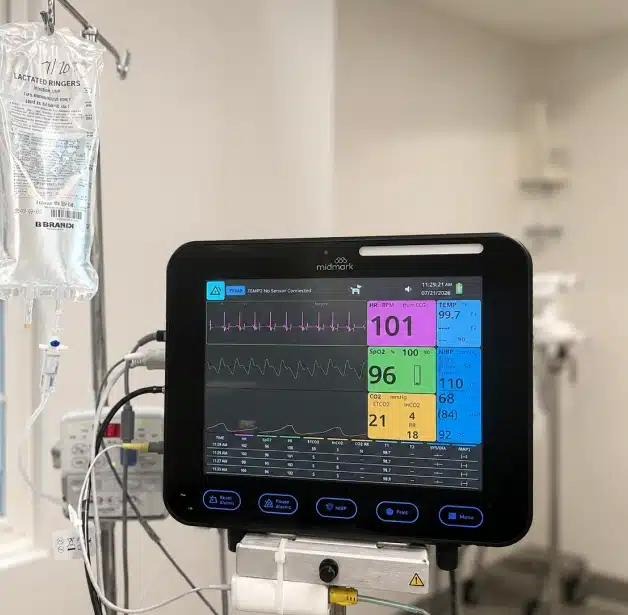
- During Surgery: A highly-trained member of our team continuously monitors your pet’s vital signs to ensure maximum safety and comfort. Pain medication is administered appropriately to help your pet wake up as comfortably as possible.
- Post-Surgical Care: After surgery, we monitor your pet closely to ensure a smooth recovery from anesthesia and provide ongoing pain management.
Types of Surgeries We Offer
- Spay/Neuter Surgery: A vital procedure for pets of all ages to prevent unwanted litters and reduce health risks. Most pets can go home the same day.
- Soft Tissue Surgery: Includes mass removal, hernia repair, laceration repair, biopsies, bladder stone removal, and more.
- Orthopedic Surgery: Specialized care for injuries or conditions involving bones, joints, and ligaments. Dr. Allan Dozier, with over 40 years of experience, has successfully performed thousands of orthopedic surgeries.
At Rea Road Animal Hospital, we’re proud to be your partner in keeping your pet happy, healthy, and thriving. Take advantage of our special offer and schedule your pet’s surgery today to take the next step in their well-being!
Spay/Neuter Procedure
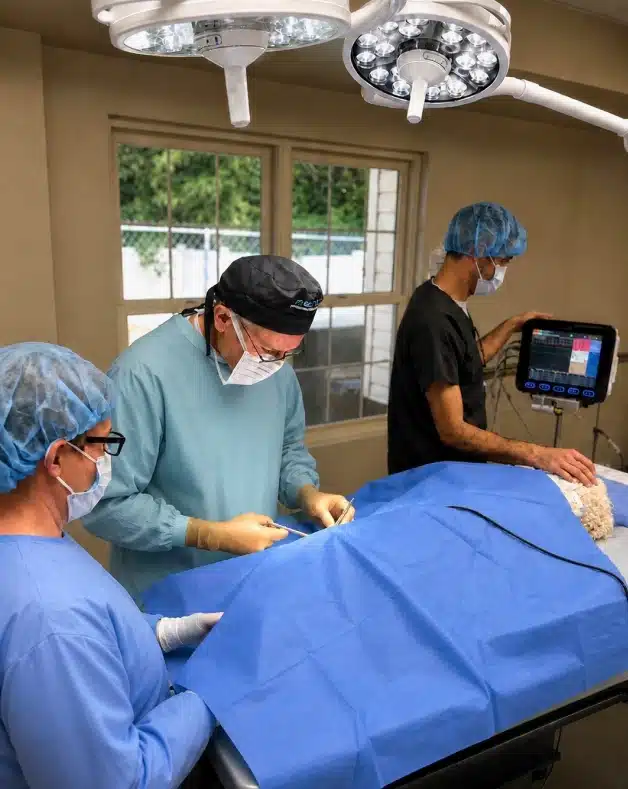
Our team of veterinary surgeons at Rea Road Animal Hospital are highly skilled in performing effective and safe spay and neuter surgeries. We suggest spaying or neutering pets once they have had all of their vaccinations, are at least 6 months old, and are not intended for breeding.
Unwanted litters are costly and time-consuming, so if you do not intend to responsibly breed your pet, spay/neuter surgery is the best option for you. In addition, thousands of animals are euthanized because shelters have reached capacity each year. For this reason, spay/neuter surgery is the best option for the community too!
Pets who are spayed or neutered tend to have longer lifespans, be more even-tempered, and better family pets. The surgery offers several other health and behavioral benefits for your pet, including:
The spay surgery for female pets prevents:
- Unwanted litters
- Heat periods
- Mammary and uterine issues, such as cancer and infections
- Undesirable behaviors, such as urine marking and howling
The neuter surgery for male pets prevents:
- Unwanted litters
- Prostate disease and testicular cancer
- Aggressive behaviors
- Undesirable behaviors, such as urine marking and the urge to roam
As with any veterinary surgery at Rea Road Animal Hospital, you can be sure you and your pet are in the right care and will be treated with the utmost care and compassion.
Orthopedic Surgery
Dr. Allan Dozier has been performing veterinary orthopedic surgery for 40 years and has been a certified Tibial Tuberosity Advancement (TTA) surgeon since 2005. He has performed this surgery on approximately 1,000 dogs of all sizes and on a wide range of ages and conditions. Rea Road Animal Hospital only uses all-titanium implants from their inventor, Kyon Inc.
One of the most common orthopedic problems in dogs is a ruptured ligament in the knee, called an anterior cruciate ligament (ACL) in humans or cranial cruciate ligament (CCL) in dogs. This injury makes the knee unstable and leads to severe arthritis if it is not treated. Also, on the surface of the tibia is a leathery cartilage structure called the meniscus that may be torn. A torn meniscus can intensify lameness and arthritis. Most cases we see today have a degenerative condition of the ligament and are not related to trauma alone. There are different surgical procedures used to repair the injured knee and not one method is best for all dogs.
ACL Surgery for Dogs
There are three main procedures to repair an ACL rupture in dogs. The simplest and least expensive procedure is called extracapsular stabilization/lateral suture, or figure eight technique. In this procedure, we place a piece of heavy suture on the outside of the joint to mimic the angle of the torn ACL. This suture material will break or become loose in all dogs in some months or years but fibrous (scar) tissue develops that replace the loosening suture. The disadvantages are
- Recovery and reusing the leg takes longer.
- The developing fibrosis causes increased thickening of the leg.
- Your dog may tear the artificial ligament before the fibrosis occurs, and we may need to perform the surgery again.
The latest procedure is called the tightrope technique. This is a modification of the extracapsular method but uses a very strong braided material of gel-spun polyethylene. The material is anchored in the bone on both tibia and femur so is much more secure than the above procedure. Dr. Dozier is experienced in this procedure, and it has, for the most part, replaced extracapsular surgery at Rea Road. Disadvantages are that even though the material is very strong it will probably eventually wear, plus the bone itself may wear where the suture exits.
Alternatively, we can alter the geometry of the knee. Tibial plateau leveling osteotomy (TPLO) involves sawing the top of the tibia and rotating the top piece until the plateau is level and perpendicular to the patella tendon, changing the weight-bearing surface. A large plate enhances stability. The procedure has good results. It is versatile but also more intricate and invasive than other procedures.
The other geometric technique is tibial tuberosity advancement (TTA). Developed by Kyon Inc. in Switzerland, the attachment of the large patellar tendon moves forward to allow the patellar tendon to exert force, preventing instability caused by the ruptured ACL. The TTA changes the forces to match the tibial slope while the TPLO changes the slope to match the forces. In all the procedures, the joint is opened, remnants of the torn ligament removed, the meniscus is inspected and trimmed if also torn. Dogs recover quicker and the complication rate is lower than the other three procedures. TTA can be performed on very small dogs up to giant breeds. A recent study showed that 98.4% of dogs with ACL rupture were good candidates for TTA.
ACL Repair Treatment
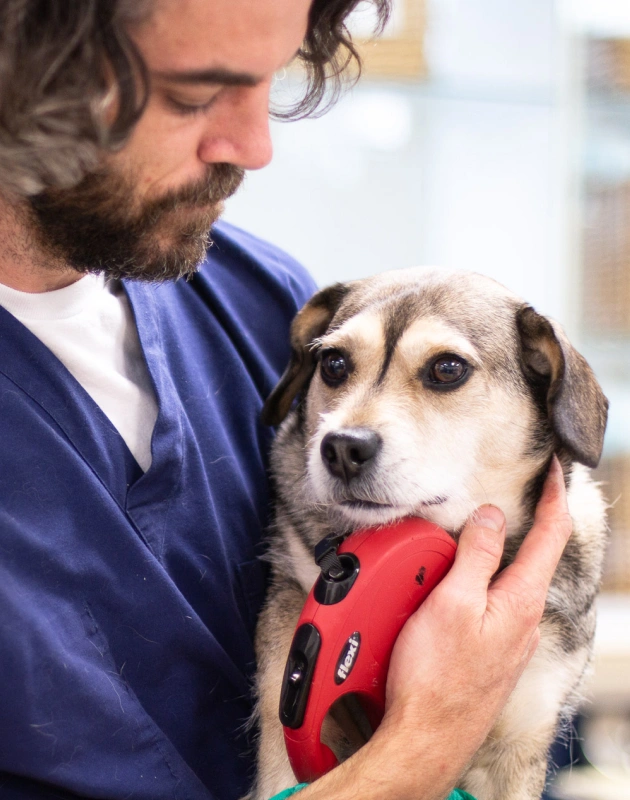
Anterior Cruciate Ligament (ACL) tears in dogs are typically due to chronic stress on the joint and, once torn, can severely impact mobility. About 85% of orthopedic surgeries performed on dogs are due to ACL ruptures. Once the ACL is torn, walking can become very difficult or impossible. It’s important to note the beginning signs of an ACL tear in your pet. If left untreated, the continued stress will inevitably continue to deteriorate, causing pain and decrease in mobility for your pet.
A variety of signs can result from an ACL injury, including subtle lameness, complete avoidance of putting weight on the leg, and sticking out injured leg to the side when sitting.
Warning: About half of dogs will tear their second ACL after tearing the first, however, there is some belief by veterinarians that proper rehabilitation can decrease the chance of tearing the second ACL.
Surgery
There are several approaches when addressing a torn ACL, but the most frequent is the tibial tuberosity advancement surgery (TTA). At Rea Road Animal Hospital, Dr. Allan Dozier and Dr. Lauren Forhecz and their team are highly trained and experienced to perform a modern variation of this procedure. Dr. Forhecz has been doing TTA’s under the direct supervision and mentoring of Dr. Dozier for the last 9 months.
Once the ACL surgery is complete, and your pet is ready to go home, your pet will be given an e-collar to wear to prevent damage to the incision. In order to prevent further injury or delayed recovery, we recommend keeping the e-collar on at home. During the course of recovery, we provide rehabilitation and physical therapy to maximize the healing process. We use Nocita for pain and inflammation and we also suggest laser therapy on the surgery site. When it’s time, the sutures will be removed.
Postoperative Recovery
It is important to keep a close watch on your pet post surgery. If you find your pet isn’t using the leg or skipping, something could be wrong or they could be in pain. We recommend bringing him or her in within 24 hours so we can identify the issue.
As with any surgery, follow-up visits are crucial for your pet’s recovery process. Our team will need to see your pet on a weekly basis in order to evaluate the healing process and assess the cast. During a post-operative visit, we will make adjustments to the cast based on how your pet is walking and will update our therapy plans each week to ensure a successful healing process.
Remember, follow-up visits are included in the surgery cost! We are here to help every step of the way, and encourage you to call us with any questions or concerns.
Soft casts are to remain clean and dry since moisture can be damaging to the casts’ integrity and may interfere with the healing process. Our staff will provide your pet with a boot to wear outside, and if you notice your pet constantly licking the cast, we ask that you keep the boot on full time.
Physical therapy is essential in promoting accelerated healing, building strong muscles, and regaining muscle memory. Prior to physical therapy visits, be sure your pet has had enough play time and was taken outside before the session to ensure maximum focus and benefits!
Laparoscopy
Just like an endoscopy is a minimal invasive procedure to help diagnose internal issues, a laparoscopy is a minimal invasive surgery to help fix those issues. A laparoscopy uses a narrow tube with a camera on the end to make small incisions in the skin. For many human procedures, laparoscopies are the standard of effectiveness and safety. Some circumstances where a pet will need a laparoscopy include:
- Collecting biopsy samples for diagnostic purposes
- Gastropexy, a life-saving emergency stomach surgery in certain breed dogs
- Correcting undescended testicles in male pets
Prior to surgery, the pet’s abdomen will be inflated with carbon dioxide in order to have enough space for safe movement within the body. During the surgery, a veterinarian uses instruments that can be inserted to make smaller incisions, and uses a monitor to complete the procedure on screen.
Laparoscopy procedures for pets provide many benefits, including:
- Quicker recovery times
- Less post-operative pain
- Shorter surgeries; less time under anesthesia
- Less bleeding during surgery
At Rea Road Animal Hospital, we are proud to offer laparoscopy procedures in-house using cutting-edge modern technology and care of our highly-trained team.
Pain Management
Our goal at Rea Road Animal Hospital is to help your pet live their healthiest and longest life possible, beginning with knowing how to manage their pain. Since your pet can’t tell you when or where they’re in pain, it’s important to be aware of the signs and symptoms in order to help manage pain and seek the appropriate treatment timely.
Two types of pain your pet can suffer from are acute pain and chronic pain.
- Acute pain is sudden, sharp, and not long-lasting. This type of pain is subdued when the pain is addressed. For example, dental disease or a surgical procedure can produce acute pain.
- Chronic pain
Whether acute or chronic pain, providing appropriate pain management is vital for your pet’s quality of life.
Common signs or symptoms of pet pain can include:
- Lethargy or lack of energy
- Restlessness or seeking comfort
- Aggression when handled or approached
- Changes to mobility and walking
- Crying or Whining
- Inability to defecate or diarrhea
- Seeking more or less attention than usual
- Changes in sleeping or eating patterns
- Decreased grooming
- Body language that can imply discomfort, such as tail between legs or flattened ears
In order to manage pain in pets, some treatment plans may include:
- Medication: Typically the best and easiest option, medication is prescribed by a veterinarian and is most recommended for chronic pain. It is important to note that medication should always be prescribed to your pet, as certain medications (including human medication) can be dangerous and potentially life threatening.
- Laser Therapy: Laser therapy is a great option for a non-invasive treatment which helps with the healing process. In most cases, after only one session you will see a difference in your pet’s behavior and symptoms. Veterinarians can recommend the duration and number of sessions depending on the severity of your pet’s pain.
- Supplements: Supplements are another way to manage your pet’s pain in a holistic and natural way. Be sure to ask your veterinarian if this is an option that should be considered for treatment.
New Furry Friends Welcome.
Schedule a Same-Day or Next Day Visit!